Learning to read becomes much easier when children understand that printed letters represent spoken sounds.
That is the purpose of phonics.
Phonics teaches beginners how to connect letters with sounds, blend those sounds to read words, and separate words into sounds when spelling. Instead of asking a child to memorize every word, phonics gives the child a practical method for working words out.
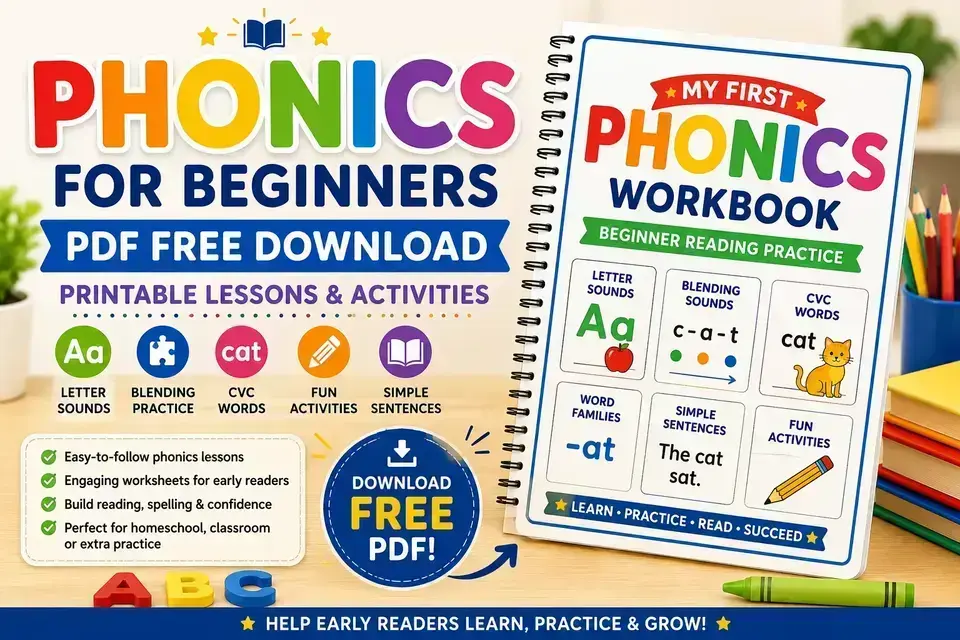
To help parents, teachers, tutors, and homeschoolers get started, this guide includes a “Phonics for Beginners” PDF free download containing simple lessons and printable activities for early readers.
The workbook covers:
- Beginning letter sounds
- Short vowel sounds
- Sound blending
- CVC words
- Word families
- Simple sentence reading
- Spelling and handwriting practice
- A progress checklist
Download the Free Phonics for Beginners PDF
The printable workbook accompanying this article is designed for children who are beginning to recognize letters and learn their most common sounds.
It can be used:
- At home
- In preschool or kindergarten
- During literacy centres
- In tutoring sessions
- As extra reading practice
- With English-language learners
- During homeschool lessons
The activities move from individual sounds to short words and sentences, allowing children to build skills gradually.
What Is Phonics?
Phonics is an approach to reading instruction that teaches the relationships between written letters and spoken sounds.
For example:
- The letter “m” commonly represents the sound heard at the beginning of “map.”
- The letter “s” commonly represents the sound heard at the beginning of “sun.”
- The letters “sh” can work together to represent the sound at the beginning of “ship.”
Once children know several letter sounds, they can combine them to read words. A beginner might sound out “sat” as
/s/ – /a/ – /t/
The child then blends the sounds together:
sat
Phonics instruction is intended to help beginning readers use letter–sound relationships and spelling patterns when reading and writing.
Why Is Phonics Important for Beginners?
Beginning readers often see an unfamiliar word and do not know where to start. Phonics gives them a repeatable process:
- Look at the letters.
- Say the corresponding sounds.
- Blend the sounds.
- Read the complete word.
- Check whether the word makes sense.
Research reviewed by the National Reading Panel found strong benefits from systematic phonics instruction, particularly when skills are taught through a planned sequence rather than introduced randomly.
The U.S. Department of Education’s foundational-reading practice guide also recommends helping children develop awareness of speech sounds, connect those sounds with letters, decode words, analyze word parts, and read connected text regularly.
Phonics is not the whole of reading instruction. Children also need vocabulary, oral language, fluency, comprehension, writing, and exposure to enjoyable books. However, phonics provides an essential foundation for recognizing and decoding written words.
What Should Beginner Phonics Lessons Teach First?
A beginner phonics program should follow a clear sequence. The exact order may differ between schools and curricula, but children generally progress through the following stages.
| Stage | Beginner skill | Example |
|---|---|---|
| 1 | Hearing sounds in spoken words | Identifying the first sound in sun |
| 2 | Connecting letters and sounds | Knowing that s can represent /s/ |
| 3 | Blending sounds | /m/ /a/ /t/ → mat |
| 4 | Segmenting words | dog → /d/ /o/ /g/ |
| 5 | Reading CVC words | cat, hen, pig, log, sun |
| 6 | Learning common digraphs | sh, ch, th, ck |
| 7 | Reading short sentences | “The cat sat.” |
| 8 | Building fluency | Reading familiar words smoothly |
A common mistake is introducing too many letter sounds at once. Beginners usually make better progress when they learn a small group of useful sounds and immediately practice combining them into words.
Start With Listening Activities
Before children can confidently match sounds with letters, they need to notice sounds in spoken language.
This ability is called phonological awareness. At the beginner level, useful activities include:
- Recognising words that rhyme
- Clapping syllables
- Identifying the first sound in a word
- Identifying the last sound in a word
- Blending spoken sounds
- Separating a spoken word into sounds
Try saying:
“I am thinking of an animal. Its name begins with /d/. It is a dog.”
The child does not need to see the written letter during every listening activity. The goal is to help the child hear and work with sounds first.
Teach Letter Sounds Clearly
Show the child a letter and model its most common sound.
For example:
- s — /s/ as in sun
- a — /a/ as in apple
- t — /t/ as in tap
- p — /p/ as in pan
- i—/i/ as in in
- n — /n/ as in net
Keep the sound clean and short. For instance, pronounce m as /m/, rather than adding a strong “uh” sound and saying “muh.” Extra sounds can make blending more difficult.
After modeling a sound, ask the learner to:
- Repeat it.
- Trace the letter.
- Find the letter among several choices.
- Name an object beginning with that sound.
- Use the sound in a simple word.
Introduce Sounds in Useful Groups
Teaching letters alphabetically is familiar, but it does not always allow children to build words quickly.
A group such as s, a, t, p, i, n can be combined to make several early words:
- sat
- sit
- tap
- tip
- pin
- pan
- pat
- tin
- nap
Being able to read real words early can be highly motivating. The child sees that learning a handful of sounds already has a practical purpose.
Teach Children How to Blend Sounds
Blending means combining separate sounds to pronounce a complete word.
Write the word map and point beneath each letter:
m – a – p
Say each sound slowly:
/m/ /a/ /p/
Then move your finger smoothly beneath the word and say:
map
Invite the learner to repeat the process.
Continuous blending
Some beginners find it helpful when sounds are stretched and joined without long pauses:
mmmmmaaaaap — map
Sounds such as /m/, /s/, /f/, /n/, and /l/ are easier to stretch. Stop sounds such as /t/, /p/, /b/, and /d/ should remain short.
Start with two sounds when necessary
A child who struggles with three-sound words can begin with combinations such as the following:
- at
- in
- it
- am
- an
- up
Once the learner can blend two sounds, move to three-sound words.
Practice Segmenting for Spelling
Segmenting is the reverse of blending.
When blending, a child turns sounds into a word:
/c/ /a/ /t/ → cat
When segmenting, a child separates a word into sounds:
cat → /c/ /a/ /t/
To practice, say a simple word and ask the child to push one counter forward for each sound.
For fish, the child should hear three sounds:
/f/ /i/ /sh/
Although “fish” contains four letters, it contains three phonemes because “sh” represents one sound.
Use CVC Words for Early Reading Practice
CVC stands for consonant–vowel–consonant. Examples include:
- cat
- bed
- pig
- log
- sun
These words are useful because they often contain three clearly distinguishable sounds.
Short A words
- cat
- map
- pan
- tap
- jam
- bag
Short E words
- bed
- hen
- leg
- net
- red
- ten
Short I words
- pig
- sit
- fin
- lip
- win
- dig
Short O words
- dog
- log
- pot
- hop
- fox
- top
Short U words
- sun
- cup
- bug
- run
- mud
- hut
Not every short English word follows a completely regular pattern. Choose clearly decodable examples during the earliest lessons and explain exceptions when they arise.
Introduce Word Families Carefully
Word families contain words with the same ending pattern.
For example, the “-at” family includes
- cat
- bat
- hat
- mat
- rat
- sat
Word families help children notice patterns. However, learners should still examine and blend the sounds rather than memorising each word only by its overall shape.
Other useful beginner word families include:
| Word family | Examples |
| -an | can, fan, man, pan |
| -ap | cap, map, nap, tap |
| -et | get, jet, net, wet |
| -in | fin, pin, tin, win |
| -ig | big, dig, fig, pig |
| -op | hop, mop, pop, top |
| -ug | bug, hug, mug, rug |
| -un | bun, fun, run, sun |
Add Common Consonant Digraphs
A digraph is a pair of letters that represents one sound.
Beginner-friendly consonant digraphs include:
- sh — ship
- ch — chip
- th—thin or this
- ck — duck
- ng — ring
Start with one digraph at a time. Compare examples, ask children to locate the letter pair, and practice reading words containing it.
For example:
sh
- shop
- shut
- fish
- dish
Remind learners that the two letters work together as a team.
Move From Words to Short Sentences
Children need opportunities to apply phonics knowledge in connected text, not only isolated word lists.
Start with short sentences containing mostly familiar sound patterns:
- Sam sat.
- The cat is on the mat.
- A red hen ran.
- Tim can dig.
- The dog is in the sun.
A sentence should be easy enough for the child to decode without guessing from a picture.
After the child reads it, ask a simple comprehension question:
- Who sat?
- Where is the cat?
- What color is the hen?
- What can Tim do?
This keeps meaning at the center of the reading activity.
How to Use the Free Phonics PDF
The downloadable workbook works best when it is used in short, focused sessions.
Suggested 15-minute routine
| Time | Activity |
| 2 minutes | Review familiar sounds |
| 3 minutes | Teach one new sound or pattern |
| 4 minutes | Blend and read words |
| 3 minutes | Complete a workbook activity |
| 3 minutes | Read a sentence or short book |
Stop before the learner becomes tired or frustrated. A brief successful lesson is more valuable than a long session that ends in conflict.
Repeat pages when necessary
The workbook does not need to be completed in one sitting or used only once. Place frequently used pages in plastic sleeves and let the child write on them with a dry-erase marker.
Say sounds aloud
Phonics is both visual and auditory. Encourage the child to say sounds and words rather than completing every activity silently.
Adjust the level
A child who already knows basic letter sounds may begin with blending or CVC words. A child who cannot yet identify beginning sounds should spend more time on listening games and letter–sound matching.
Five Easy Phonics Activities for Beginners
1. Sound hunt
Choose a sound and look for objects beginning with it.
For /b/, the child might find the following:
- book
- bag
- ball
- box
Avoid examples in which the letter has an unusual sound.
2. Letter-sound sorting
Place two letter cards on a table, such as m and s. Give the child picture cards or say words aloud. Ask the child to sort each item according to its first sound.
3. Tap and blend
Write a CVC word. Ask the learner to tap beneath each letter while saying the sound, then slide a finger beneath the whole word while blending.
4. Build the word
Use magnetic letters, bottle-cap letters, or paper tiles. Say “sun” and ask the child to choose the letters “s,” “u,” and “n.”
5. Change one sound
Build the word cat. Change the first sound to make hat. Then make hot, followed by hot.
This activity helps children notice that changing one phoneme changes the word.
Common Phonics Mistakes to Avoid
Teaching letter names without letter sounds
Letter names are useful, but knowing that a symbol is called “em” does not automatically tell a child how to decode mat. Teach both the letter name and its sound.
Adding extra sounds
Pronouncing t as “tuh” can cause a child to blend tap as “tuh-a-puh.” Model the shortest, cleanest version of each sound.
Asking children to guess
Pictures and sentence context can support comprehension, but they should not replace attention to letters. When a child meets an unfamiliar word, guide the child back to the printed spelling.
Moving too quickly
A learner may recognize a sound on a flashcard but still struggle to use it in a word. Review and application are necessary before moving on.
Using worksheets alone
Worksheets can reinforce learning, but children also need spoken practice, direct teaching, hands-on word building, books, and conversation.
Correcting every error immediately
Give the child a moment to notice and repair an error. Try prompts such as:
- “Look at the first sound.”
- “Say each sound.”
- “Blend it again.”
- “Does that match every letter?”
Signs That a Beginner Is Making Progress
Look for gradual improvement rather than instant fluency.
A learner is progressing when the child can
- Identify an increasing number of letter sounds
- Hear the first and last sounds in simple words
- Blend two or three sounds
- Segment CVC words
- Read familiar word families
- Decode rather than guess
- Read short sentences with growing accuracy
- Spell simple words using plausible letters
- Correct some mistakes independently
- Show greater confidence around print
Keep a brief record of the sounds and word patterns the child knows. This makes it easier to choose the next lesson.
When a Child Finds Phonics Difficult
Difficulty with phonics does not mean a child is lazy or incapable of learning to read.
Some learners need:
- More repetition
- Slower teaching
- Smaller steps
- Clearer modelling
- Multisensory practice
- Fewer distractions
- Additional review
- Individual support
Return to the last skill the child could complete successfully and rebuild from there.
Persistent difficulties with speech sounds, letter recognition, blending, word reading, or spelling should be discussed with the child’s teacher or another qualified literacy professional. Early support can help identify the type of instruction the learner needs.
Beginner Phonics Teaching Checklist
Use this checklist when planning a lesson:
- Review previously taught sounds.
- Teach only one manageable new skill.
- Model the skill clearly.
- Let the child respond aloud.
- Include blending practice.
- Include segmenting or spelling practice.
- Read at least one word or sentence.
- Correct errors calmly.
- End with a successful task.
- Record what needs to be reviewed.
Frequently Asked Questions
What age should a child begin phonics?
Many children begin formal phonics instruction during preschool, reception, or kindergarten. Readiness varies, so instruction should match the child’s oral-language development, sound awareness, and familiarity with print.
Should beginners learn uppercase or lowercase letters first?
Children should eventually recognize both. Lowercase letters deserve particular attention because they appear more frequently in ordinary books and sentences.
How many letter sounds should be taught each week?
There is no single pace suitable for every learner. Introduce a manageable number, provide daily review, and check that the child can use the sounds in blending and word reading before moving too far ahead.
Should letter sounds be taught in alphabetical order?
Not necessarily. Many phonics programs teach sounds in an order that allows children to build useful words early. A set such as s, a, t, p, i, n can produce several beginner words.
What are the best first words for phonics?
Regular two- and three-sound words are often easiest. Examples include at, in, sat, pin, map, hen, dog, and sun.
What is the difference between phonics and phonemic awareness?
Phonemic awareness concerns the ability to hear and manipulate individual sounds in spoken words. Phonics connects those sounds to written letters or letter groups.
Can worksheets teach a child to read?
Worksheets can provide valuable practice, but they should be combined with explicit instruction, oral sound activities, word building, decodable reading practice, storytelling, and meaningful conversation.
How often should a beginner practice phonics?
Short, regular practice is usually more manageable than occasional long sessions. A focused lesson of approximately 10–20 minutes may be suitable for many beginners, depending on age, attention, and individual needs.
Final Thoughts
A useful phonics resource should do more than present a collection of disconnected worksheets. It should guide children from hearing sounds to recognizing letters, blending words, spelling simple patterns, and reading short sentences.
Use the free phonics for beginners PDF alongside direct teaching, spoken practice, hands-on activities, and enjoyable reading. Move at the learner’s pace, review often, and celebrate small improvements.
The most important sign of progress is not how quickly a child completes the workbook. It is whether the child is becoming more accurate, independent, and confident when approaching written words