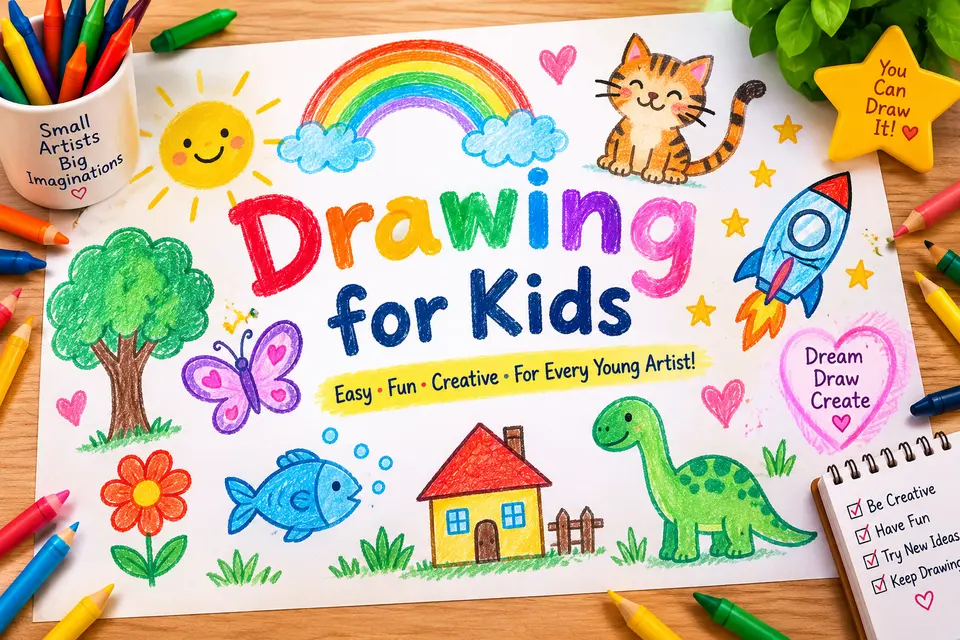
A blank sheet of paper can become almost anything—a smiling sun, a tiny dinosaur, an underwater world, or a rocket heading toward the stars.
But there is one problem many young artists run into:
“I don’t know what to draw!”
That is where a good collection of drawing ideas for kids can help.
Children do not need expensive art supplies or advanced skills to start drawing. Many beginner pictures can be created from circles, triangles, squares, straight lines, and simple curves. Recent beginner drawing guides likewise emphasize starting with familiar subjects and simple shapes rather than complicated details.
Below are 25 easy drawings kids can try at home, during quiet time, or as part of a classroom art activity.
What Do Kids Need to Start Drawing?
You can keep the supplies very simple.
Start with:
- Drawing or printer paper
- Pencils
- Erasers
- Crayons
- Colored pencils
- Washable markers
A sketchbook is useful if a child enjoys drawing regularly, but it is not necessary.
For beginners, starting in pencil can also make the activity feel less intimidating because lines can easily be changed before color is added.
25 Easy Drawing Ideas for Kids
| Drawing idea | Main shapes | Difficulty |
|---|---|---|
| Smiling sun | Circle and lines | Very easy |
| Rainbow | Curved lines | Very easy |
| Flower | Circles and curves | Very easy |
| Balloon | Oval and line | Very easy |
| Fish | Oval and triangle | Easy |
| House | Square and triangle | Easy |
| Ice cream cone | Circle and triangle | Easy |
| Caterpillar | Circles | Easy |
| Cat face | Circle and triangles | Easy |
| Apple | Circle and curves | Easy |
| Butterfly | Circles and curves | Easy |
| Tree | Lines and circles | Easy |
| Ladybug | Circle and lines | Easy |
| Cupcake | Curves and lines | Easy |
| Boat | Triangle and curves | Easy |
| Teddy bear | Circles and ovals | Easy |
| Rocket | Oval and triangles | Easy |
| Dinosaur | Ovals and curves | Medium |
| Friendly monster | Any shapes | Easy |
| Robot | Squares and rectangles | Easy |
| Castle | Squares and triangles | Medium |
| Underwater scene | Mixed shapes | Medium |
| Space scene | Circles and stars | Medium |
| Funny face | Circles and curves | Easy |
| Imaginary creature | Any shapes | Anything goes! |
Now, let’s turn some of those ideas into drawings.
1. Smiling Sun
A smiling sun is an excellent first drawing because it uses only a few basic marks.
How to draw it:
- Draw a large circle.
- Add two small eyes.
- Draw a curved smile.
- Add lines around the circle for rays.
- Color the sun yellow, orange, or any color you like.
Creative challenge: Give your sun sunglasses, a hat, freckles, or a funny expression.
2. Colorful Rainbow
A rainbow gives children plenty of room to experiment with color.
Start with one large curved line. Draw several more curved lines underneath it, following the same shape.
Add fluffy clouds at both ends and color the rainbow.
Children do not have to worry about making every curve perfectly even. Loose lines can make the finished picture more playful.
3. Simple Flower
Start with a circle for the middle of the flower.
Draw petals around it, followed by a long stem and two leaves.
Once the basic flower is finished, children can create an entire garden by changing the colors, petal shapes, heights, and patterns.
Try this: Add a bee, butterfly, sunshine, or watering can to turn one flower into a complete garden scene.
4. Easy Balloon
Draw a large oval.
Add a tiny triangle underneath for the knot and a long wavy line for the string.
That’s it.
Now comes the fun part: decorating it.
Try stripes, dots, stars, hearts, zigzags, or a silly face.
5. Cute Fish
A fish can be built from just a few familiar shapes.
- Draw a large oval for the body.
- Add a triangle for the tail.
- Draw an eye.
- Add a curved mouth.
- Draw fins and scales.
- Color the fish.
This is also an easy picture to expand. Add bubbles, seaweed, shells, rocks, or another fish to create an underwater scene.
6. Little House
A simple house teaches children how basic shapes can work together.
Draw a square or rectangle for the building and place a triangle on top for the roof.
Then add:
- A door
- Windows
- A chimney
- A path
- Flowers
- Trees
- Clouds
Encourage children to imagine who lives inside. Maybe it belongs to a family, a wizard, a mouse, or even a friendly dragon.
7. Ice Cream Cone
Draw a triangle pointing downward for the cone.
Add one, two, or three round scoops of ice cream on top.
Then decorate them with sprinkles, chocolate chips, cherries, syrup, or silly faces.
There is no rule saying ice cream has to be brown, pink, or white. A young artist might invent blue moon ice cream with golden stars.
8. Wiggly Caterpillar
Draw several circles next to one another.
The first circle becomes the head. Give it two eyes, a smile, and antennae.
Add little legs underneath the remaining circles.
Coloring every section differently turns a very simple drawing into a bright finished picture.
9. Cute Cat Face
Start with a large circle.
Add:
- Two triangle ears
- Two eyes
- A small triangle nose
- A curved mouth
- Whiskers
Children can customize their cats with stripes, spots, fluffy cheeks, bows, glasses, or different expressions.
10. Shiny Apple
Draw a rounded apple shape.
Add a small stem and leaf at the top.
For extra detail, draw a small curved white area on one side to represent shine.
Then try drawing a basket containing several apples.
11. Easy Butterfly
Draw a small oval for the butterfly’s body and a circle for its head.
Add two large wings on either side, followed by two smaller wings underneath.
Finish with antennae.
The wings provide plenty of space for children to experiment with dots, stripes, hearts, swirls, and different colors.
12. Happy Tree
Draw two lines for the trunk and connect them near the bottom.
Above the trunk, use several large, rounded shapes to create the leafy top.
Children can change the picture according to the season:
Spring: pink blossoms
Summer: bright green leaves
Autumn: red, orange, and yellow leaves
Winter: bare branches and snow
One basic tree can become four completely different drawings.
13. Little Ladybug
Start with a circle or oval.
Draw a line down the middle for the wings and add a smaller shape for the head.
Then add dots, legs, antennae, and eyes.
For a more imaginative version, let children choose their own colors instead of sticking with the familiar red-and-black pattern.
14. Yummy Cupcake
Draw a small cup shape for the wrapper.
Add a large curved shape on top for the frosting.
Finish with sprinkles, fruit, a cherry, or a candle.
Drawing challenge: Design the world’s craziest cupcake. What toppings would it have?
15. Sailboat
Draw a curved shape for the boat.
Add a straight vertical line for the mast and one or two triangles for the sails.
Draw wavy lines underneath for water.
The background can include clouds, birds, an island, a lighthouse, or a giant sea creature hiding beneath the waves.
16. Teddy Bear
Teddy bears look complicated until you break them into shapes.
Begin with a large circle for the head.
Add two smaller circles for the ears and an oval for the muzzle. Then draw the eyes, nose, mouth, body, arms, and legs.
Do not worry if both sides are not identical. A slightly crooked ear can give a teddy bear more personality.
17. Rocket Ship
Ready to leave Earth?
Draw a long oval or rounded rectangle for the rocket body.
Add a pointed top, fins on the sides, and a round window.
Underneath, draw flames blasting from the engine.
Then surround the rocket with stars, planets, moons, or friendly aliens.
18. Friendly Dinosaur
Dinosaurs can be easy to draw when children start with large shapes instead of details.
Draw an oval for the body and a smaller shape for the head. Connect them with a neck.
Add four legs and a long curved tail.
Depending on the dinosaur, children can add spikes, plates, horns, or spots.
The goal does not have to be scientific accuracy. It can simply be a fun dinosaur.
19. Silly Monster
This activity has one important rule:
There are no rules.
A monster might have:
- Five eyes
- Three arms
- Purple fur
- Giant feet
- Tiny wings
- Striped horns
- One enormous tooth
Open-ended prompts like this give children freedom to invent rather than copy a predetermined picture.
20. Funny Robot
Robots are ideal for practicing geometric shapes.
Start with a square for the head and a rectangle for the body.
Add rectangular arms and legs, then decorate the robot with buttons, antennas, screens, lights, gears, or wheels.
Creative question: What special job does your robot do?
Maybe it cleans bedrooms. Maybe it makes pancakes. Maybe it explores Mars.
21. Magical Castle
Draw one large rectangle for the main building.
Add tall rectangles on each side for towers.
Place triangles on top for roofs.
Then add windows, flags, doors, bricks, and a winding path.
Children who want an extra challenge can surround the castle with mountains, forests, dragons, or a moat.
22. Underwater World
Instead of drawing one object, create an entire scene.
Start with several fish.
Then add:
- Seaweed
- Bubbles
- Coral
- Shells
- Starfish
- Rocks
- A treasure chest
Older children can add more detail, while younger children can stick with simple shapes.
23. Outer Space Scene
Draw a large planet and surround it with smaller planets, moons, and stars.
Then add a rocket, astronaut, satellite, or imaginary alien spacecraft.
Space is especially useful for imaginative drawing because the picture does not need to represent an everyday scene.
24. Funniest Face Ever
Start with a circle.
Then ask the child to make the funniest face possible.
Try enormous eyes, tiny ears, wild hair, crooked teeth, long eyebrows, or a huge mustache.
This is a simple way to practice facial features without worrying about creating a realistic portrait.
25. Invent Your Own Creature
Once children are comfortable following drawing prompts, encourage them to create something that does not already exist.
Ask questions such as:
- Where does the creature live?
- What does it eat?
- Can it fly?
- How many legs does it have?
- Does it have fur, feathers, scales, or something completely new?
- What special power does it have?
Give the creature a name when the drawing is finished.
That small storytelling element can turn a quick sketch into a much bigger creative activity.
Easy Drawing Ideas for Kids by Age
Age ranges should be treated as flexible guidelines rather than strict rules. Children develop drawing skills at different rates, so interest and current ability matter more than choosing a picture simply because it is assigned to an age group.
| Age | Drawing ideas to try |
|---|---|
| Ages 3–4 | Scribbles, circles, sun, balloons, caterpillars |
| Ages 4–5 | Rainbows, flowers, fish, simple faces |
| Ages 5–6 | Houses, cats, butterflies, trees |
| Ages 6–8 | Robots, dinosaurs, rockets, castles |
| Ages 8+ | Detailed animals, landscapes, characters and imaginative scenes |
The basic progression—from simple marks and shapes toward recognizable objects and more detailed scenes—is also reflected in age-oriented drawing guidance.
How to Make Drawing Easier for Beginners
Start With Big Shapes
Before worrying about eyes, feathers, scales, windows, or other small details, look for the biggest shapes in the picture.
A fish might begin as an oval.
A house can begin as a square and triangle.
A robot can begin as rectangles.
Breaking pictures into manageable shapes makes seemingly complicated subjects much easier to approach.
Draw Lightly With a Pencil First
Encourage beginners to make light pencil marks.
They can adjust the shapes before adding darker outlines and color.
Add Details Last
Think big to small.
Draw the main shape first. Add secondary shapes next. Save tiny details and decorations until the basic picture works.
This approach is commonly used in beginner step-by-step drawing activities because it reduces a complicated subject to manageable parts.
Leave Room for Creativity
A step-by-step tutorial should be a starting point, not a rulebook.
If the example has a yellow butterfly and a child wants a rainbow butterfly with square wings, that is a perfectly useful creative choice.
What If a Child Says, “I Can’t Draw”?
Avoid making perfection the goal.
Instead of focusing only on whether the finished picture looks “right,” ask about what the child created:
“Tell me about your monster.”
“Where is your rocket going?”
“What is your cat’s name?”
Questions like these shift attention from comparison toward imagination and storytelling.
It is also worth remembering that children’s drawings do not have to resemble an adult’s version of the same subject. Drawing can be open-ended: different children can respond to the same prompt in completely different ways.
Fun Drawing Challenges for Kids
Once basic drawings become easy, turn them into mini challenges.
Try:
- Draw an animal using only circles.
- Invent a new planet.
- Draw your dream bedroom.
- Design a treehouse.
- Create a superhero.
- Draw a pet that does not exist.
- Design a new kind of vehicle.
- Draw what you would see under the ocean.
- Combine two animals into one creature.
- Draw a tiny world inside a bottle.
- Draw your favorite food as a cartoon character.
- Create a map leading to hidden treasure.
These prompts remove the pressure to copy a picture exactly and encourage children to make decisions of their own.
Drawing Games for Kids
Drawing can also become a group activity.
Finish the Picture
One person draws a random shape or line.
The next person must turn it into something recognizable.
A squiggly line might become a snake, river, dragon tail, or roller coaster.
Pass the Drawing
One child begins a picture and then passes the paper to someone else.
Each person adds something new.
Nobody knows what the finished picture will look like.
Mystery Drawing
One person secretly chooses an object and describes it without saying its name.
Everyone else tries to draw it from the description.
At the end, compare the pictures.
Create-a-Creature
Take turns choosing features.
One person chooses the number of eyes. Another chooses the legs. Someone else decides whether the creature gets wings, horns, fur, scales, or a tail.
Then everyone draws their own version.
Common Drawing Mistakes Adults Can Avoid
Children are learning, so adult expectations can influence whether drawing feels playful or stressful.
Expecting Perfect Results
A child’s picture does not need perfect proportions or straight lines to be successful.
Correcting Every Line
Constant correction can turn a creative activity into an exercise in following instructions.
Demonstrate a technique when help is wanted, but leave room for children to make their own choices.
Choosing Pictures That Are Too Difficult
A highly detailed drawing can frustrate a beginner.
Start with something achievable and gradually introduce more complicated subjects.
Doing the Drawing for Them
It can be tempting to “fix” a picture.
Instead, draw an example on a separate sheet if a child needs help. They still get to make their own version.
Comparing Children’s Artwork
Two children can follow exactly the same instructions and produce completely different pictures.
That difference is part of the activity, not a problem that needs correcting.
Frequently Asked Questions About Drawing for Kids
What is the easiest drawing for kids?
Simple pictures built from familiar shapes are usually easiest for beginners. A smiling sun is a good starting point because children mainly need to draw a circle, facial features, and lines for rays. Fish, balloons, flowers, rainbows, and caterpillars are other approachable choices.
What should a beginner child draw?
Start with familiar subjects such as a sun, flower, house, fish, balloon, rainbow, tree, or simple animal face. Once those feel comfortable, move toward pictures containing more shapes and details.
What can kids draw when they are bored?
Kids can draw imaginary animals, dream houses, treasure maps, robots, dinosaurs, underwater worlds, space scenes, favorite foods, cartoon faces, or their own superheroes.
How can I make drawing fun for children?
Offer choices, keep the activity relaxed, use interesting prompts, and allow children to change the example. Drawing games and storytelling can also make art time more engaging.
Do children need special art supplies to learn drawing?
No. Basic paper and a pencil, crayon, colored pencil, or washable marker are enough for many children’s drawing activities. More supplies can be introduced later if the child enjoys experimenting with art.
How can kids get better at drawing?
Regular practice helps children become more comfortable controlling lines, recognizing shapes, and adding details. Instead of trying to make every picture perfect, encourage them to experiment with different subjects and gradually try more challenging drawings.
Final Thoughts
Drawing for kids should feel creative before it feels complicated.
Start with circles, squares, triangles, ovals, and simple lines. Turn those shapes into a sun, fish, house, butterfly, robot, rocket, or anything else a child can imagine.
As confidence grows, add more details and bigger challenges.
And when a drawing comes out differently than expected?
Keep it.
Sometimes the wobbly line, enormous ear, crooked window, or strangely shaped dinosaur becomes the best part of the picture.