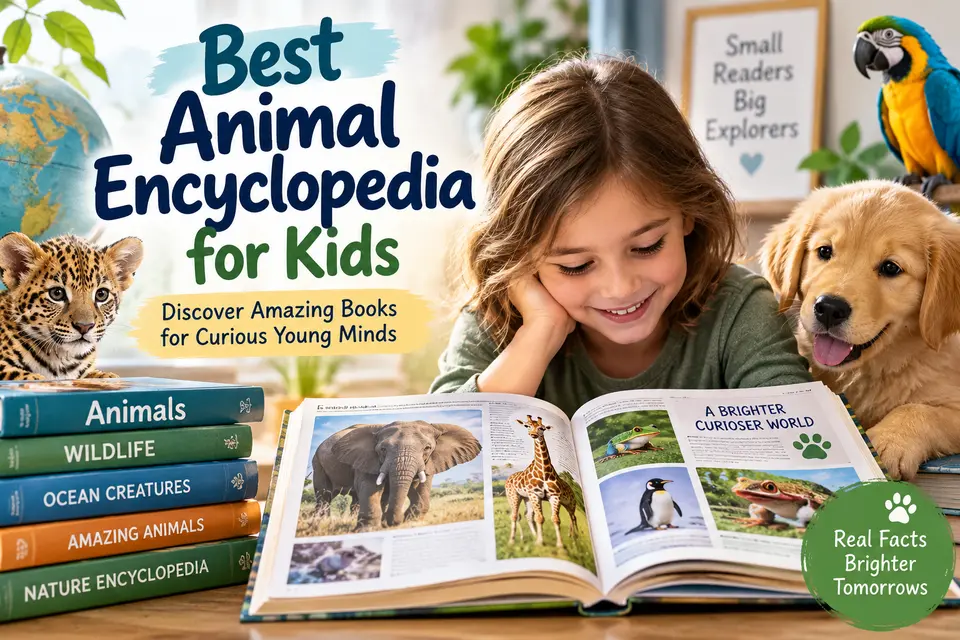
Some children read an animal encyclopedia because they need to finish a school project. Others open one to look up a tiger and somehow end up twenty minutes later reading about axolotls, dung beetles, or why flamingos are pink.
The second kind of reading is where a really good encyclopedia earns its place on the bookshelf.
The best animal encyclopedia for kids shouldn’t feel like a textbook disguised as a children’s book. It needs enough reliable information to answer real questions, photographs or illustrations worth lingering over, and a layout that lets a child wander from one discovery to another.
There isn’t one book that does this equally well for every age. A six-year-old who loves big animal pictures needs something very different from an eleven-year-old who wants to understand classification, ecosystems, anatomy, and animal behavior.
Here are seven strong choices, with a closer look at which child each one suits best.
Best Animal Encyclopedias for Kids at a Glance
| Book | Best for | Suggested age/level | What makes it stand out? |
|---|---|---|---|
| National Geographic Kids Animal Encyclopedia, 2nd Edition | Best overall | Ages 8–12 | Broad coverage, photography, maps, and accessible reference information |
| Animals: A Children’s Encyclopedia | Best traditional reference book | Roughly ages 9–12 | More than 700 photographs plus habitat maps and illustrations |
| Why? Animals | Best for children who ask lots of questions | Ages 7–9 | More than 200 animal questions in short, approachable sections |
| Eyewitness Encyclopedia of Animals | Best for older, curious readers | Ages 9+ | 1,500+ images, facts, quizzes, and expert interviews |
| An Anthology of Intriguing Animals | Best gift book | Ages 6–8 | Beautiful presentation and stories about more than 100 animals |
| Knowledge Encyclopedia Animal! | Best for science-minded kids | Ages 9–12 | Detailed 3D imagery, biology, habitats, ecosystems, and classification |
| The Very Hungry Caterpillar’s Very First Animal Encyclopedia | Best first animal encyclopedia | Younger learners | Friendly illustrations, photography, diagrams, and bite-size explanations |
1. National Geographic Kids Animal Encyclopedia, 2nd Edition — Best Overall
For a child who wants one substantial book covering animals from around the world, National Geographic Kids Animal Encyclopedia, 2nd Edition, is an easy place to start.
Published in 2021, the hardcover runs to 304 pages and is listed for children ages 8–12 and grades 3–7. The publisher also gives it a Lexile level of 1020L.
Its strength is balance. This is a proper reference book, but it still looks inviting enough for a child to pick up without an assignment hanging over their head.
That matters more than it sounds. Dense reference books can contain wonderful information and still spend most of their lives unopened. Animal encyclopedias work particularly well for children when the photographs pull them in first and the text rewards them once they’re there.
Best for: Elementary and middle-grade readers who want a broad animal reference they can return to for both schoolwork and independent reading.
Possible drawback: Children at the younger end of elementary school may be happier with a book built around shorter text and simpler page layouts.
Why It Earns the Top Spot
It occupies a useful middle ground. It isn’t a preschool introduction, but neither does it demand the patience of a serious zoology reference book.
For many families, that’s exactly what an animal encyclopedia needs to be: interesting enough for casual browsing and substantial enough to stay useful as the child grows.
2. Animals: A Children’s Encyclopedia — Best Traditional Animal Reference Book
DK has been making highly visual reference books for decades, and Animals: A Children’s Encyclopedia follows that familiar photograph-rich approach.
The updated edition contains more than 700 photographs along with illustrations and habitat maps. Its coverage reaches beyond simply identifying animals. Children can explore where animals live, what they eat, how they behave, what their young are like, and how different species fit into habitats around the world.
This is the sort of encyclopedia that works particularly well when a child says, “I need information about cheetahs,” rather than, “I want a story about cheetahs.”
The distinction is useful. Some books on this list are designed primarily to spark curiosity. This one is closer to a bookshelf reference tool that also happens to be visually appealing.
Best for: Families, homeschoolers, classrooms, and children who regularly need reliable background information for projects.
Where This Book Has an Advantage
Habitat maps are a small feature with a big educational payoff.
Knowing what a snow leopard looks like is one thing. Seeing where it lives starts connecting the animal to geography, climate, habitat, food, and survival. An encyclopedia becomes much more useful when it helps children make those connections instead of treating every species as an isolated collection of facts.
3. Why? Animals — Best for Kids Who Never Stop Asking Questions
“Why?” can be an exhausting word for a parent.
For a young animal lover, however, it is often the beginning of real learning.
Why? Animals take that natural curiosity and make it the organizing idea of the book. The 144-page encyclopedia is aimed at ages 7–9 and answers more than 200 questions about animals. Its chapters cover major groups, including mammals, birds, insects, reptiles, amphibians, and fish. Photography, illustrations, and diagrams accompany the explanations.
Instead of expecting a child to sit down and read a long reference entry, the book offers a question, an answer, and another reason to turn the page.
That can make it especially appealing to children who enjoy nonfiction but don’t necessarily want to read several uninterrupted paragraphs at a time.
Best for: Ages 7–9, reluctant readers, fact collectors, and children whose conversations are filled with questions about how animals work.
A Different Kind of Encyclopedia
There is a useful lesson here for parents choosing nonfiction.
Reading level isn’t only about whether a child can understand the words. It is also about whether the presentation gives them a reason to keep reading.
Question-led pages provide natural stopping points. A child can read three questions and walk away or get hooked and read thirty. Both count.
4. Eyewitness Encyclopedia of Animals — Best for Older Kids Who Want More Detail
A nine-year-old who has already worked through several basic animal books may not want another collection of introductory facts.
Eyewitness Encyclopedia of Animals offers considerably more to explore.
Published in 2025, this 272-page encyclopedia is designed for ages 9 and older. According to DK, it contains more than 1,500 images as well as facts, statistics, quizzes, and interviews with people who work with or study animals, including zoologists, entomologists, veterinary surgeons, and deep-sea explorers.
Those expert perspectives give the book another dimension. Animals aren’t presented only as things to identify; children also get glimpses of the people who study them.
For a reader beginning to wonder what zoologists actually do—or what studying animals might look like as a career—that is a meaningful addition.
Best for: Ages 9+, strong readers, serious animal enthusiasts, and children interested in wildlife science.
When to Choose This Instead of a Simpler Encyclopedia
Choose it when “What animal is that?” has started turning into “How does that animal survive?”
Older children are ready to make connections between anatomy, behavior, adaptation, environment, and scientific study. Giving them a book with enough depth prevents their curiosity from outrunning the material too quickly.
5. An Anthology of Intriguing Animals — Best Animal Encyclopedia to Give as a Gift
Some reference books are practical.
An Anthology of Intriguing Animals is practical, but it is also the kind of book that looks as though someone thought carefully about how it would feel to own.
Designed for ages 6–8, the 224-page book explores more than 100 animals through photographs, illustrations, facts, stories, and even some of the myths associated with different creatures.
The selection moves between familiar favorites and animals children may know less about. That makes browsing unpredictable in a good way. A child can arrive looking for tigers and leave with a new fascination for pangolins.
The writing also leans closer to storybook-style descriptions than a conventional reference entry. For children making the transition from picture books to independent nonfiction, that softer approach can be a good fit.
Best for: Ages 6–8, birthdays and holidays, shared reading, and children who appreciate beautiful books as much as animal facts.
What Parents Should Know
This wouldn’t be my first choice if the main purpose is researching dozens of species for school assignments.
That isn’t what it does best.
Its real appeal is discovery. It encourages children to look closely, read a little further, and become interested in animals they didn’t know enough about to search for in the first place.
6. Knowledge Encyclopedia Animal!—Best for Science-Minded Kids
At some point, “cool animal facts” may stop being enough.
A child starts wanting to know why a body is shaped a certain way, how species are classified, what happens inside an animal, or how a creature fits into its ecosystem.
That’s the territory of Knowledge Encyclopedia Animal!
The 288-page hardcover uses photography, illustrations, charts, fact files, timelines, and detailed 3D CGI imagery. Its subject matter reaches into biology, ecosystems, habitats, evolution, extinction, classification, and endangered animals. The book is aimed at ages 9–12.
This isn’t simply a directory of species.
It is more useful for a child who wants to understand the animal kingdom rather than collect disconnected facts about individual animals.
Best for: Ages 9–12, science enthusiasts, homeschool study, visual learners, and children ready for more sophisticated concepts.
Why the Visual Approach Helps
Some animal science is difficult to understand from a paragraph alone.
A cutaway, diagram, comparison, or carefully constructed 3D image can explain relationships that would otherwise require much more text. For children who understand a concept more quickly once they can see it, this style of encyclopedia has an obvious advantage.
7. The Very Hungry Caterpillar’s Very First Animal Encyclopedia — Best First Animal Encyclopedia
A child’s first encyclopedia shouldn’t require an adult to translate every paragraph.
The Very Hungry Caterpillar’s Very First Animal Encyclopedia takes a gentler route into reference reading. It combines the familiar illustrated world associated with Eric Carle with animal photography, simple diagrams, and small pieces of information.
The 224-page book moves through different animal groups and introduces creatures including koalas, armadillos, eagles, penguins, turtles, frogs, sharks, and butterflies.
That mixture of illustration and real photography is particularly useful for children moving beyond storybooks. The pages still feel friendly, but real animals and factual explanations begin taking center stage.
Best for: Young children getting their first substantial animal reference book, especially those who already enjoy The Very Hungry Caterpillar.
Don’t Buy a Book Just Because a Child Can Grow Into It
Parents naturally want books to last. Sometimes that leads to buying an encyclopedia several years above a child’s current reading level.
A little challenge is healthy. A book that feels like homework every time it opens is less helpful.
For a younger child, the better investment may be an encyclopedia they will enthusiastically use now. Curiosity can grow into more complicated books later.
How to Choose the Best Animal Encyclopedia for Your Child
Age recommendations are helpful, but they shouldn’t make the entire decision.
Two eight-year-olds can have completely different relationships with nonfiction. One may happily read full pages about ecosystems. The other may spend an hour studying photographs and reading only captions.
Watch how the child already reads.
A child who constantly asks questions may click with Why? Animals. One who studies pictures before reading anything may prefer a visually intensive DK encyclopedia. A confident older reader who wants a book for research needs more depth. A younger child who is just beginning to explore nonfiction needs an inviting entry point, not the biggest book available.
Think About What “Animal Lover” Means to Your Child
The phrase covers a surprisingly wide range of interests.
Some children want dangerous predators. Some are obsessed with ocean life. Others care about tiny insects, animal babies, strange adaptations, habitats, or record-breaking creatures.
A broad encyclopedia is the safest choice when interests change every week. A more detailed reference works better once the child has begun asking questions about biology and animal behavior rather than simply identifying species.
Look Beyond the Number of Animals
“Features thousands of animals” sounds impressive on a cover, but a huge species count doesn’t automatically make a children’s encyclopedia better.
Coverage has to be usable.
A book containing fewer animals but giving each one enough room for meaningful photographs, habitat information, behavior, and explanation may teach a child more than an enormous catalog of names and thumbnail pictures.
Good Pictures Should Do More Than Decorate the Page
Children’s animal encyclopedias are visual books, so photographs and illustrations deserve almost as much attention as the writing.
Look for images that reveal scale, anatomy, habitat, movement, camouflage, or behavior. Maps can show where species live. Diagrams can explain body structures. Comparisons can make size understandable.
The best visuals answer questions of their own.
What Age Is Best for an Animal Encyclopedia?
There isn’t a minimum age at which children suddenly become ready for encyclopedias.
For preschool and early elementary ages, adults can treat a visual encyclopedia as a shared book. You don’t need to start on page one or finish a chapter. Let the child choose an animal, study the picture, read a few facts aloud, and follow whatever question comes next.
Independent readers around ages 7–9 can usually handle more structured entries and question-and-answer formats. By ages 9–12, many children are ready for classification, adaptation, ecosystems, anatomy, evolution, and other concepts that make a detailed reference book worthwhile.
Reading ability matters, but interest can stretch it considerably. A child will often tackle surprisingly difficult nonfiction when the subject happens to be the animal they cannot stop talking about.
Are Animal Encyclopedias Useful for School?
Yes, particularly as a starting point.
A well-organized encyclopedia can help a child understand the basic vocabulary and context of a topic before moving on to more specialized sources. Habitat maps, animal groups, diagrams, and concise species profiles are particularly handy for reports and science projects.
For formal school research, though, teach children to check publication dates and use more than one reliable source when needed. Wildlife science changes. Conservation status, population estimates, taxonomy, and other details can be updated after a printed book reaches the shelf.
That isn’t a reason to avoid encyclopedias. It is a good opportunity to teach children what reference books are for—and where their limits are.
For further exploration, National Geographic Kids’ animal library organizes online animal information into mammals, birds, reptiles, amphibians, invertebrates, and fish.
FAQ About Animal Encyclopedias for Kids
What is the best animal encyclopedia for kids?
For a broad, all-around reference, National Geographic Kids Animal Encyclopedia, 2nd Edition, is a strong choice for ages 8–12. It offers a substantial 304-page introduction to the animal world and is designed specifically for elementary and middle-grade readers.
For younger children, a more visual first encyclopedia may be easier to enjoy independently. Older children who want greater scientific depth may prefer the Eyewitness Encyclopedia of Animals or the Knowledge Encyclopedia Animal!
What is the best animal encyclopedia for a 7-year-old?
Why? Animals and An Anthology of Intriguing Animals are particularly good candidates. The former suits children who enjoy short questions and answers, while the latter works well for children drawn to beautiful illustrations, photographs, and story-like descriptions. Their different formats matter more than choosing between them based on age alone.
What is the best animal encyclopedia for a 10-year-old?
A curious ten-year-old can handle considerably more detail. Eyewitness Encyclopedia of Animals, Knowledge Encyclopedia Animal!, and National Geographic Kids Animal Encyclopedia, 2nd Edition, are all worth considering. The best choice depends on whether the child prefers visual browsing, deeper science, or a broad general reference.
Are DK animal encyclopedias good for children?
Many of DK’s children’s animal books use a strongly visual reference format, combining photography, illustrations, diagrams, and relatively short sections of text. The publisher currently categorizes children’s animal titles across several age bands, including 5–7, 7–9, and 9–11 years.
That variety is useful because “DK animal encyclopedia” can describe books with very different levels of difficulty. Check the specific title rather than assuming every book from the publisher is suitable for the same age.
Should I buy a general animal encyclopedia or one about a specific type of animal?
Start with a general encyclopedia if the child’s interests move from sharks to snakes to big cats from one week to the next.
A specialized book makes more sense when an interest has lasted long enough that the general encyclopedia no longer answers the child’s questions. At that point, books devoted to oceans, insects, birds, dinosaurs, reptiles, or another favorite subject can add real depth instead of duplicating information they already know.
Final Verdict: Which Animal Encyclopedia Should You Buy?
If you want one book with broad appeal for a school-age animal lover, National Geographic Kids Animal Encyclopedia, 2nd Edition, is my pick for the best overall option. Its age range, substantial coverage, and reference-friendly format make it a sensible book to keep rather than quickly outgrow.
But age changes the answer.
For a younger child encountering animal reference books for the first time, The Very Hungry Caterpillar’s Very First Animal Encyclopedia offers a friendlier introduction. Why? Animals is a clever fit for a seven- to nine-year-old who learns by asking questions. Knowledge Encyclopedia Animal! and Eyewitness Encyclopedia of Animals give older readers somewhere to go once basic facts aren’t enough.
And if the book is a gift? An Anthology of Intriguing Animals has an advantage that specifications can’t really capture: it is designed to be browsed, admired, revisited, and kept.
Ultimately, that’s a better test than page count.
The right animal encyclopedia is the one a child pulls off the shelf without being told to.