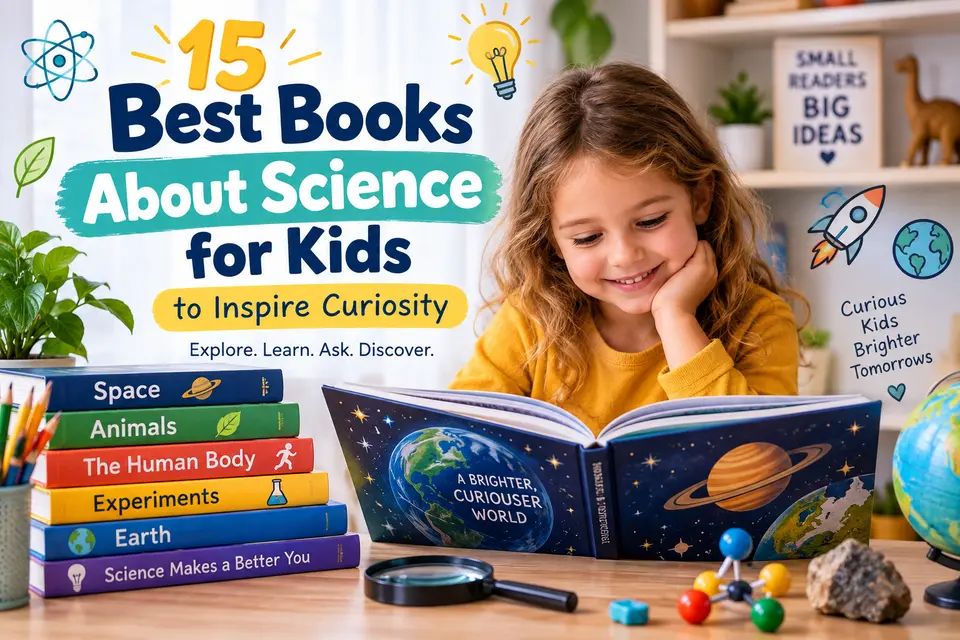
Why does thunder make such a loud noise? What is inside an atom? How does the human heart keep beating? Could people really live on Mars?
Kids ask questions that can turn an ordinary afternoon into an unexpected science lesson.
The right science book doesn’t simply provide an answer. It gives children another question to investigate.
That’s why choosing books about science for kids is less about finding the thickest encyclopedia and more about matching the book to the child. A seven-year-old who wants to build things may love a hands-on engineering book, while a ten-year-old fascinated by planets might happily spend hours exploring a visual space encyclopedia.
Below are 15 science books and book types worth considering, covering everything from experiments and engineering to biology, Earth science and astronomy.
Quick Guide: Choosing a Science Book by Age
Age recommendations are useful starting points rather than rigid rules. Reading ability, attention span and existing interest can make a big difference.
| Age | Good Science Book Features | Topics to Try |
|---|---|---|
| 3–5 | Large pictures, simple explanations, read-aloud text | Animals, plants, weather, dinosaurs |
| 5–7 | Short facts, illustrations, simple activities | Nature, space, the body, basic experiments |
| 7–9 | Questions, diagrams, experiments, deeper explanations | Biology, chemistry, Earth, engineering |
| 9–12 | Detailed reference material, projects, scientific concepts | Physics, technology, astronomy, STEM |
The strongest choice is usually a book that feels slightly challenging without turning reading into homework.
1. National Geographic Kids Science Encyclopedia
Best for: Ages 8–12
Good choice for: The child who wants a little bit of everything
For a broad introduction to science, the National Geographic Kids Science Encyclopedia is an excellent place to start.
The newly updated second edition was published in August 2026 and is aimed at readers ages 8–12. Its coverage stretches from atoms to zero gravity, making it useful for children whose interests bounce between subjects rather than staying in one scientific field.
That’s an advantage in a family reference book. A child can start by looking up one question and end up discovering something completely different.
Why consider it:
- Broad science coverage
- Strong visual presentation
- Suitable for browsing as well as reference
- Helpful for school-age children exploring several branches of science
Explore National Geographic Kids books
2. Knowledge Encyclopedia Science!
Best for: Ages 9–11+
Good choice for: Visual learners
Some children understand a concept much faster when they can see it.
DK’s Knowledge Encyclopedia Science! uses striking visual material to explore subjects such as molecules, magnetism, storm clouds and tectonic plates. DK recommends the title for roughly ages 9–11.
It’s particularly appealing for kids who enjoy diagrams, detailed images and dipping into a book rather than reading every chapter in order.
3. The Usborne Science Encyclopedia
Best for: Ages 8+
Good choice for: Kids who like combining books with online exploration
The Usborne Science Encyclopedia extends the traditional reference-book experience with digital resources.
Usborne’s current Quicklinks resources for the book are designed for ages 8+ and connect readers with experiments, videos, homework resources and more than 1,000 recommended websites. The resources also include downloadable images that can be useful for projects and schoolwork.
For a child who reads something interesting and immediately wants to investigate further, that extra layer can be particularly useful.
Explore The Usborne Science Encyclopedia resources
4. Ask a Scientist by Robert Winston
Best for: Ages 7–9
Good choice for: Kids who constantly ask “why?”
Some young readers aren’t looking for a formal introduction to biology or physics. They have questions.
Lots of them.
Ask a Scientist is built around 100 questions from children, with answers from scientist Robert Winston. Topics range from volcanoes to plants and the peculiar reasons our bodies behave as they do.
The question-and-answer format makes it especially approachable for reluctant readers because there’s no requirement to work through a long chapter before discovering something interesting.
5. Science Is Magic by Steve Mould
Best for: Ages 5–7
Good choice for: Young experimenters
A science activity becomes much more exciting when the result looks impossible.
Science Is Magic combines simple scientific projects with the appeal of magic tricks. DK describes activities including levitating tinsel and optical effects, using them as opportunities to introduce the science behind what children observe.
That combination can help younger children understand an important lesson early: science isn’t merely a collection of facts. It’s a way of figuring out why things happen.
6. STEM Lab
Best for: Ages 9–11
Good choice for: Hands-on learners and makers
If your child would rather build something than read about it, try a project-focused STEM book.
STEM Lab introduces science, technology, engineering and mathematics through step-by-step projects. Activities highlighted by DK include building a wind-up car, wind turbine, suspension bridge and geodesic dome.
Projects give abstract concepts a physical result. Instead of simply reading about forces or engineering, children get to test what happens when their design actually has to work.
7. How to Be an Engineer
Best for: Ages 7–9
Good choice for: Builders, inventors and problem-solvers
Engineering is a particularly useful doorway into science for children who enjoy LEGO, machines, construction or figuring out how objects work.
How to Be an Engineer introduces engineering through practical projects and everyday science. Activities include exploring jet propulsion with balloons and constructing a simple robot arm using rulers.
It’s a good reminder that a science-loving child doesn’t necessarily want a book filled with facts. Some want a problem to solve.
8. Science You Can Eat by Stefan Gates
Best for: Ages 7–9
Good choice for: Children who think science books sound boring
Food provides a surprisingly effective introduction to scientific thinking.
Science You Can Eat explores science through familiar—and occasionally strange—foods. Its topics include chewing gum, unusual fruits, color-changing cabbage and other food-related phenomena.
Children already have experience with melting, freezing, mixing, heating and tasting. Connecting scientific ideas to those everyday experiences can make unfamiliar concepts easier to grasp.
9. My Amazing Body Machine
Best for: Ages 7–9
Good choice for: Kids fascinated by the human body
The human body offers endless questions.
Why does your heart beat faster when you run? What does your brain actually do? How do all the body’s systems work together?
My Amazing Body Machine introduces young readers to human biology with colorful papercraft artwork and accessible facts about organs including the brain and heart.
It’s a strong choice for children whose scientific curiosity begins with themselves.
10. The Bacteria Book
Best for: Ages 7–9
Good choice for: Kids who enjoy gross science
Sometimes the easiest way into science is through something wonderfully disgusting.
The Bacteria Book introduces young readers to the microscopic world in an intentionally playful way. DK positions it as a book particularly capable of engaging reluctant readers through strange and “gross” facts.
Microbiology can feel abstract because children can’t simply look around and see bacteria. An entertaining introduction helps make that invisible world more tangible.
11. Did You Know? Earth
Best for: Ages 7–9
Good choice for: Future geologists and Earth explorers
Earth science has plenty of spectacle: meteorites, caves, volcanoes, fossils, mountains and dramatic weather.
Did You Know? Earth uses a question-led format to explore subjects including sinkholes, stalactites, mammoths and meteors.
It’s a useful pick for children who prefer jumping between fascinating facts rather than following a continuous narrative.
12. Try This! 50 Fun Experiments for the Mad Scientist in You
Best for: Experiment-loving school-age children
Good choice for: Home and classroom activities
Reading about the scientific method is useful. Actually making a prediction and discovering that reality disagrees with you is better.
National Geographic Kids includes Try This! 50 Fun Experiments for the Mad Scientist in You among its science resources for readers and educators.
Experiment books can help children practise several scientific habits at once: observing carefully, asking questions, predicting results and learning from outcomes.
Adult supervision should always match the materials and activity involved.
13. Coral Reefs by Jason Chin
Best for: Approximately ages 5–9
Good choice for: Children who prefer stories to encyclopedias
Not every great science book needs to look like a reference book.
Jason Chin’s Coral Reefs uses imaginative storytelling and illustrations to carry a young reader into the world of coral reefs. Smithsonian highlighted the book for ages 5–9 and praised the way its visual premise turns a trip to the library into an exploration of a reef ecosystem.
Books like this are especially valuable for children who love stories but haven’t yet decided that they “like science.”
14. The Tiny Seed by Eric Carle
Best for: Young children
Good choice for: A first introduction to plant science
Before children need terminology such as germination or pollination, they can understand a simpler idea: a tiny seed can become a plant.
Eric Carle’s The Tiny Seed follows a seed through its life cycle. Smithsonian has recommended it as a science-related choice for children around ages 3–6.
For preschool and early elementary readers, that combination of story and natural observation can be more appropriate than a fact-heavy science book.
15. A Child-Chosen Book About Their Favorite Science Topic
Best for: Any age
Good choice for: Building genuine long-term interest
This final recommendation isn’t a single title.
It’s a strategy.
Take a child to a library or bookstore and let them choose one science subject that fascinates them.
Dinosaurs count. Sharks count. Tornadoes count. Robots, insects, volcanoes, black holes, electricity and the human brain all count.
A book doesn’t need to cover every branch of science to encourage scientific curiosity. A deep fascination with one subject often creates connections to others naturally.
A dinosaur enthusiast encounters evolution, anatomy, geology and climate. A child fascinated by rockets soon runs into physics, engineering, mathematics and astronomy.
Interest can be the doorway.
What Makes a Good Science Book for Kids?
A beautiful cover can attract attention, but what’s inside matters more.
Look for a book that explains rather than simply dumps facts on the page. Strong children’s science books tend to use age-appropriate language, meaningful illustrations or diagrams, specific examples and questions that encourage further investigation.
Accuracy matters too. Science publishing ages differently from fiction. Subjects such as space exploration, technology and scientific discoveries continue to change, so check the publication or edition date when current information is important.
For example, the second edition of the National Geographic Kids Science Encyclopedia was released in August 2026 as a fully updated edition.
Match the Book to How Your Child Learns
Two excellent science books can produce completely different reactions from the same child.
A visual learner may gravitate toward large photographs, cutaways, diagrams and illustrated encyclopedias.
A hands-on learner may get more from experiment and engineering books.
A story lover might prefer narrative nonfiction, biographies of scientists or picture books built around nature.
A fact collector may happily disappear into encyclopedias, almanacs and question-and-answer books.
And a reluctant reader may respond better to gross facts, strange animals, dramatic photographs or short sections that don’t demand sustained reading.
Don’t confuse a poor match with a lack of interest in science.
Science Books vs. Science Experiment Books
You don’t necessarily have to choose between them.
Reference books answer questions and introduce concepts. Experiment books give children a chance to test ideas themselves.
Used together, they can create a simple learning cycle:
Read → wonder → predict → experiment → observe → ask another question.
That last step matters. A successful science activity isn’t one that leaves a child with nothing else to ask. It’s one that creates the next question.
Good Science Topics for Kids
If you’re building a home or classroom science shelf, variety is more useful than buying five general encyclopedias.
Consider covering:
- Space and astronomy
- Animals and habitats
- Human biology
- Plants
- Dinosaurs and fossils
- Earth science
- Weather
- Chemistry
- Physics
- Engineering
- Inventions
- Robotics and technology
- Experiments
- Environmental science
- Biographies of scientists
This gives children different ways to discover what captures their attention.
How Parents Can Make Science Books More Engaging
You don’t need to turn reading time into a lesson.
Suppose your child reads that some animals migrate enormous distances. Instead of immediately explaining migration, ask where they think the animal is going and why.
If a book describes an experiment, ask what they predict will happen before trying it.
When a child encounters an unfamiliar word, investigate it together.
Most importantly, let interesting detours happen. If three pages about planets lead to an hour of questions about whether humans could survive on Mars, the book has done its job.
Common Mistakes When Choosing Children’s Science Books
Choosing by age alone. Two eight-year-olds can have very different reading abilities and scientific interests.
Buying books that are too text-heavy. Dense pages can discourage a child who would happily study the same information in a diagram.
Assuming experiments are automatically better. Some children prefer reading, collecting facts or examining illustrations.
Buying only school-related topics. A child’s unusual obsession may be the strongest route into science.
Ignoring edition dates. This matters most for fast-changing subjects such as technology and space exploration.
Turning curiosity into compulsory study. A science book sitting beside the bed can accomplish something a forced worksheet cannot: make discovery feel voluntary.
Frequently Asked Questions
What are the best books about science for kids?
Good choices include National Geographic Kids Science Encyclopedia, Knowledge Encyclopedia Science!, The Usborne Science Encyclopedia, Ask a Scientist, STEM Lab, How to Be an Engineer, and subject-specific books about biology, Earth, animals and space. The best choice depends on the child’s age and interests.
What is a good science book for an 8-year-old?
Look for books with clear explanations, strong visuals and relatively short sections. The Usborne Science Encyclopedia is listed for ages 8+, while several DK science titles are designed for the 7–9 age range.
Are science encyclopedias good for kids?
Yes, especially for children who enjoy browsing and asking questions across many subjects. A general science encyclopedia can introduce physics, chemistry, biology, Earth science and astronomy in one book.
What science books are good for younger children?
For younger readers, choose picture-led books with simple concepts, nature stories and short explanations. The Tiny Seed, for example, introduces the plant life cycle through a story suitable for young children.
How can I encourage my child to become interested in science?
Start with what already fascinates them. Animals, dinosaurs, cooking, machines, weather and space can all become gateways into scientific thinking. Follow the child’s questions rather than insisting on a particular subject.
Are experiment books good for learning science?
They can be excellent when activities are age-appropriate and safely supervised. Experiments allow children to make predictions, observe results and connect abstract scientific ideas with something they can see happening.
Final Thoughts: The Best Science Book Is the One That Creates Another Question
The best books about science for kids don’t need to turn every child into a future scientist.
They need to make curiosity worth following.
Start with the child’s age, but don’t stop there. Consider what they already talk about, build, collect, draw or ask questions about. Then choose a book that gives that curiosity somewhere to go.
A beautifully illustrated encyclopedia may be perfect for one child. Another might need 50 experiments, a book about bacteria or an entire volume devoted to dinosaurs.
If the book closes with the child asking, “But why does that happen?”, you’ve probably chosen well.
Suggested Internal Links
If your website covers children’s education, natural internal-link opportunities include:
- Best Educational Books for Kids
- Best STEM Activities for Kids
- Easy Science Experiments for Kids
- Best Space Books for Kids
- Educational Activities to Do at Home
- How to Encourage Reading in Children
Suggested External Authority Resources
For additional child-friendly science material:
- National Geographic Kids Books
- National Geographic Kids science educator resources
- Usborne Science Encyclopedia Quicklinks
Featured Image SEO
Suggested Filename: best-books-about-science-for-kids.jpg
Image Title: Best Books About Science for Kids
Alt Text: Child exploring colorful science books about space, biology, nature and experiments
Caption: The right science books can turn children’s everyday questions into opportunities for discovery.
Featured Image Concept: A bright editorial-style reading scene featuring an elementary-age child surrounded by science books, with subtle visual elements representing planets, plants, dinosaurs, atoms and experiments. Keep the composition clean and realistic, with no brand logos or small text.