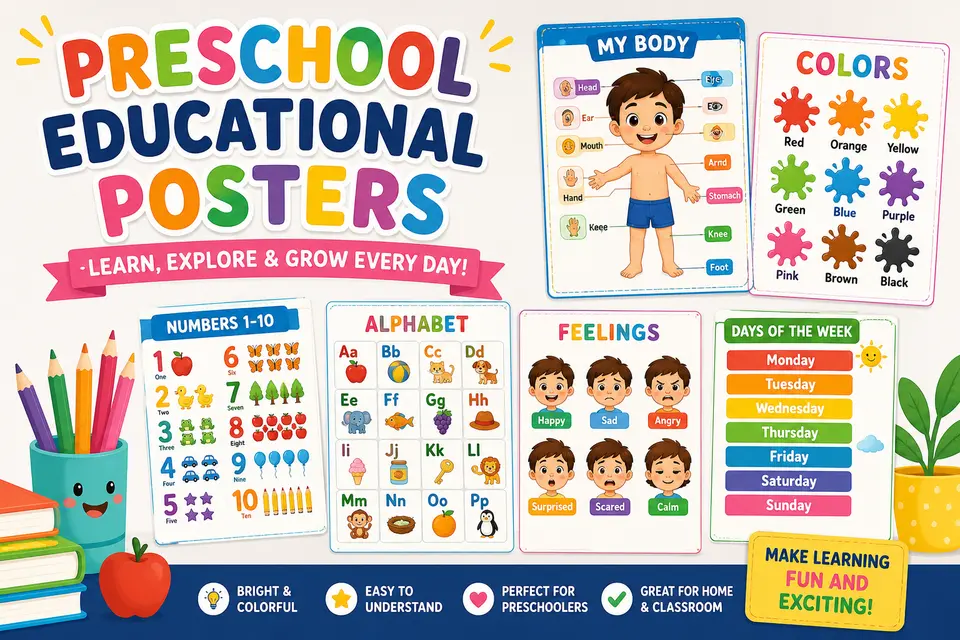
Preschool educational posters are visual learning aids that display fundamental topics such as the alphabet, counting, geometric shapes, and facial expressions. They support early reading, math, and social skills with uncluttered pictures and easy text.
Teachers and caregivers use them to establish routines, elicit questions, and support lessons with repetition. Posters that work use high-contrast colors, big type, and kid-appropriate language to enhance retention and classroom flow.
The remainder of the post goes over design advice and usage examples.
Key Takeaways
- Educational posters provide a consistent, quiet tutor that encourages learning, aids memory, minimizes distractions, and fosters independent reasoning.
- Utilize charts and sequenced visuals to scaffold cognition by dividing complex ideas into age-appropriate steps and offering repeated exposure to key concepts.
- Language and emotional literacy posters should be your first priority to increase early vocabulary, conversation, emotion recognition, and social skills. Consider bilingual versions for multicultural classrooms!
- Just as you color code your lecture notes, design preschool posters purposefully with clear type, simple images, balanced colors, and inclusive representation so materials stay legible, compelling, and culturally responsive.
- Hang posters at kid eye level, cluster them into learning niches, switch out content regularly, and take displays off the wall to tables, centers, and even digital formats for wider accessibility.
- Track impact through teacher/student feedback, changes in behavior and participation, and knowledge retention in poster activities and checks.
The Silent Teacher
Preschool posters become a silent teacher that supports student-centered learning by providing kids with material to contemplate and quiz themselves on before the adults arrive. They imprint critical concepts without explicit lecturing, allowing students to stew on the notions and build neural connections through frequent reinforcement.
Posters help cut down on big distractions by providing fixed visual reference points in the room, and they prompt questions teachers can ask before retreating, in accordance with the silent teacher method of brief instruction interspersed with long periods of student work.
1. Cognitive Scaffolding
Charts take complex concepts and reduce them to small, age-appropriate chunks so kids can handle one at a time. Sequence posters present cycles, such as day to night and life stages, to lead step-by-step thinking and construct schema.
Seeing digits, letters, and shapes all the time keeps fundamentals simmering in working memory and facilitates mastery through repetition. Teachers who keep direct talk under ten minutes allow the child to work with the poster as a scaffold and slowly transfer control to the student.
2. Language Ignition
Alphabet and sight-word charts place vocabulary where children view it often, encouraging early literacy and word recognition. Images combined with small text present new words in context, facilitating retention.
Posters are pair talk or group naming games, a low-effort way to get them talking. Bilingual displays encounter diverse classrooms and embrace English learners by displaying parallel text and images.
3. Emotional Literacy
Emotion posters provide faces and labels for children to learn to name feelings and associate them with cues. These illustrated tales help model empathy and pro-social moves, which can come in handy during circle time or those moments of conflict.
Visual cues for soothing actions provide children with mechanisms to cope with emotions prior to adult intervention. Group lessons can involve matching situations to expressions to develop social awareness.
4. Environmental Cues
Routines and rule posters are your silent teacher, making transitions more efficient and reducing teacher requests. Weather, calendar, and task charts give the predictable scaffolding that supports executive function.
Motivational displays establish precise standards, and instructional cues demonstrate sequential task flow. With consistent visuals, kids can self-manage behavior and tasks.
5. Independent Discovery
Hang posters at child height so they can read and reference unassisted. Provide diverse subject matter to allow wonder-driven mini projects and play.
Hands-on, themed exhibits encourage discovery and artistic reaction. Posters, as the silent teacher, provide learners with ‘just-in-time’ problem-solving when working ‘on the bench.’
Essential Visuals
These vital visuals anchor the classroom and serve as constant guiding references that direct early learning. Roughly 90% of the information the brain takes in is visual, so posters are a powerful tool for concept building and retention.
Foundational Concepts
For the all-important visuals, hang posters that present counting, letters, and shapes with big type and obvious images to assist the learner in associating symbols with meaning. Include color identification and matching with paired examples, such as a red apple next to the word ‘red’ and a color chart for quick drills.
Incorporate charts that track early math milestones, including number lines to 20, simple addition sets, and shape-sorting guides that move from simple to compound figures. Incorporate literacy supports such as alphabet mats with uppercase and lowercase pairs and phoneme prompts.
- Must-have posters:
- Alphabet with pictures (A-Z)
- 0-20 with dot patterns
- Core forms with real-life instances
- Main color wheel and swatches
- Number line and basic counting charts
- Decodable phonic word list
Social-Emotional Skills
Highlight images that educate sharing, cooperation, and respect with pictures of taking turns and helping. Posters help model conflict resolution and positive language with short scripts and emotion-face charts that label feelings.
Foster inclusivity by featuring diverse families, traditional attire, and multi-lingual hellos to normalize diversity. Back self-regulation and mindfulness with soothing visuals, breath guides, and quick prompts to help kids label feelings and select coping actions.
World Knowledge
Introduce world themes with vivid photos and icons to enrich knowledge of world geography, seasons, and weather. Celebrate diversity with multicultural family scenes and real-life tradition examples.
| Theme | Visual elements |
|---|---|
| Geography | Simple maps, continents in bright colors |
| Seasons | Four-panel seasonal scenes with clothing cues |
| Weather | Icons for sun, rain, snow, wind with daily chart |
| Cultures | Festivals, foods, and global family portraits |
Spark curiosity with engaging pictures and easy observation and question prompts.
Intentional Design
Intentional design is taking intentional work to clear goals for posters, classroom space, and learner outcomes. It leverages research, experimentation, and a human-centric perspective to tailor itself to young children’s necessities and constraints while seeking to enhance engagement, inquisitiveness, and analytical skill.
Well-designed increases satisfaction and learning impact. Ill-applied design can feel prescriptive and box creative use.
- Critical elements of intentional poster design:
- Mission-based content geared to standards and classroom objectives.
- Scale and legibility for viewing at normal classroom distances.
- Color and contrast decisions connected to focus and emotion.
- Emergent reader-friendly typography.
- Keep your images simple and icons clear.
- Representation across cultures, abilities, family types, and more.
- Coordinated sets to reinforce a classroom theme.
- Durability, material safety, and cleanability.
Opt for prints that fit your decor and teaching objectives. Map each poster to a lesson (alphabet, social skills, routines).
Opt for clear, concise content: single-topic posters with minimal text, one strong verb or concept per piece. Choose sets with a common palette, type, and illustrative style so walls feel like one system that backs classroom habits and eases cognitive loads.
Color Psychology
High-contrast pairs, such as blue and white, enhance calm focus and legibility. Bright yellow accents capture attention for routines or timers.
Red can indicate urgency or energetic play, yet apply it with care to prevent anxiety. Green hues promote rejuvenation and shift. Soft pastels alleviate overstimulation.
Pair a daring highlight color with two subtle supporting shades to direct the look.
Clear Typography
Choose big, sans-serif fonts for 2 to 3 meters of viewing. Be sure to have dark text on a light background or vice versa with 70 percent or more contrast.
Keep lines to phrases, not sentences. Use consistent font weights across a set to assist scanning.
Simple Imagery
Select clean art or photographs that depict a single object or activity. No busy scenes; crop to the essentials.
Choose realistic images for vocabulary and stylized icons for routines. One idea per poster maintains concentration.
Inclusive Representation
Incorporate all different skin tones, family units, abilities, and occupations. Display a variety of occupations and community helpers.
Caption people in a respectful manner. Aim for posters of inclusion and respect.
Strategic Placement
Strategic placement of posters establishes the visual logic of a preschool room and connects print to action. Hang posters and labels where kids encounter them throughout routines and play so environmental print becomes integrated into how they understand the room.
Clarity, font size, and contrast matter: choose simple type, 14 to 24 point equivalents for small groups, and clear images so text-image links form quickly. Strategically located, read and use bilingual labels to celebrate home languages and to assist emergent English learners in mapping words to objects.
Eye-Level Engagement
Post them at student eye level to encourage immediate usage and glance-based learning. For 3- to 4-year-olds, that typically translates to a height of 80 to 110 cm from the ground.
For 4- to 5-year-olds, position objects 100 to 130 cm high. Tune for furniture arrangement and typical floor or chair hangouts so kids do not have to strain or crouch to view material.
Rotate low-hanging items to keep interest and rotate in lesson-specific content. Utilize tactile add-ons such as Velcro words to welcome touch and hands-on matching of image and text.
Themed Learning Zones
Group related posters to define zones: reading corner, math table, science shelf, and art area. Strategic placement visual cues, such as colored borders, floor decals, or header posters, help children self-direct and reduce transition friction.
Align posters with daily routines and objectives: a counting strip by the math table, a plant life-cycle poster near a science tray, and labeled bins in both English and home languages. Well-located signage reinforces behavior by establishing norms of how spaces are occupied and by making routines overt.
Poster Rotation
Rotate regularly to keep displays fresh and relevant at least monthly or seasonally. Save spare posters flat in labeled folders or shallow crates for quick reuse.
Engage kids in deciding what prints come back, which fosters ownership and vocabulary. For English learners, re-present known print in new contexts to reinforce word-object associations and to support emerging vocabulary.
Beyond The Wall
Go beyond the wall and extend your posters to tables, doors, and floors to reframe the classroom as a learning canvas. Cover table tops with laminated ABC or number mats for group work. For rapid word swaps, stick magnetic posters on doors. Use floor stickers for active counting games.
This pushes learning into new territory and demonstrates the concept of going beyond the wall, which can inspire curiosity and risk-taking in young students.
Interactive Elements
Attach movable pieces or flaps or velcro to posters so kids can rearrange content and interact physically. Along with matching games, sequencing strips that stick to the poster, such as a life-cycle chart where kids put stages in order.
Make sorting pockets for colors, shapes, or letter sounds to encourage classification. Incorporate tactile materials such as felt and textured paper to develop fine motor skills by pinching, peeling, and positioning pieces.
Make some poster components detachable for mini-stations so students can facilitate segments of a lesson and socialize.
Digital Integration
Tablet-ready poster PDFs and smartboard files that correspond to each physical display allow hybrid groups to experience the same prompts. Post, for example, printable classroom posters to a common drive so that families and remote students can easily download copies.
With editable templates from online repositories, update themes, add translations, or adapt complexity for different skill levels. Bridge the digital and the traditional by scanning student-created posters and projecting them during circle time to celebrate work and link the in-class and at-home experience.
Activity Starters
Checklist: Create step-by-step tasks tied to posters—observe, point, sort, record, and reflect—that teachers or aides can follow. Organize scavenger hunts in which kids look through posters for letters, numbers, or symbols and record discoveries on a worksheet.
Assign a class project in which small groups design posters on a subject and come to present them, encouraging a sense of ownership and creativity. Incorporate posters into natural moments like calendar time to emphasize patterns and sequencing.
Measuring Impact
Posters impact kids everywhere and influence what they pay attention to and recall. Discussing measurement techniques helps connect visual presence to learning and classroom habits.
Collect input from students and teachers on favorite posters and successful displays. Employ easy, age-suited interviews and short teacher questionnaires to measure which posters attract interest, which stimulate memory, and which reinforce class regulations. Inquire with teachers about anecdotal shifts, such as a teacher who ceased verbally correcting a claim and instead pointed to a poster until students began pointing themselves.
Notice any shifts in classroom demeanor, engagement, and inspiration following poster exposure. Be purposeful in measuring the impact by conducting structured observations for a few weeks. Observe the frequency of poster reference, on-task minutes, and types of interactions around poster topics.
Note occasions when posters trigger self-regulation or cooperative learning. For example, children may refer to a steps poster during group work or a feelings chart to calm down.
Assess knowledge retention and concept mastery through poster-based activities and assessments. Design short, poster-anchored tasks such as matching cards to poster elements, quick oral quizzes where children point to answers on the poster, or rotation stations that require using the poster to solve problems.
Compare pre and post scores to quantify gains in concept mastery and retention.
| Measurement Type | Impact on Poster Utilization | Qualitative Comments |
|---|---|---|
| Reach | Increased visibility among target audience | Posters attracted more attention. |
| Engagement | Higher interaction rates | Viewers engaged with the content. |
| Retention | Improved recall of information | Information was memorable and useful. |
| Feedback | Positive responses from viewers | Many found the posters informative. |
| Measure | Quantitative Outcome | Qualitative Feedback |
|---|---|---|
| Attention to poster | 68–85% of observed intervals | “Children look when asked.” — teacher |
| On‑task time | +12 minutes per hour average | “Less redirection needed.” — teacher |
| Concept recall | +18% correct post‑test | Student points to poster to answer |
| Motivation indicators | +22% voluntary participation | “Kids try more challenging tasks.” — teacher |
Design, color, font, imagery, and interactive tech all sway these outcomes. Posters for self-regulation, summarization, and group work maximize impact.
Conclusion
Great posters accelerate learning. Vibrant pictures, simple text, and actual labels teach children to name objects and develop skills. Hang posters at kid height, close to play spots and by routines, to grab attention and jog memory. Rotate sets every few weeks to maintain interest and match lessons. Opt for long-lasting materials and washable surfaces in high-traffic rooms. Share prints with parents and staff to extend learning beyond class. Keep tabs on behavior and skill to see what works.
How about a set on feelings, colors, and words of the day? Try one wall for a month. Observe what children identify, articulate, or incorporate in play. Share results with your team and tweak. How about we get a theme picked out and run a little experiment?
Frequently Asked Questions
What is the main benefit of using preschool educational posters?
Posters offer continual visual reinforcement of language, math, and social skills. They provide passive reinforcement of learning throughout the day.
Which visuals are essential for preschool posters?
Think alphabet, numbers, shapes, colors, basic emotions, and routines. These cultivate early literacy, math, and social-emotional comprehension.
How should I design posters for young children?
Choose legible fonts, high-contrast colors, elementary images, and a small amount of text. Try to have only one concept per poster.
Where should posters be placed in a classroom?
Hang at child eye level by learning centers, book nooks, and sinks. Change up the location to keep the material fresh and contextual.
How can posters support behavior and routines?
Implement visual schedules, step guides, and emotion charts. They reduce nagging and assist kids in self-governing.
How do I measure a poster’s impact on learning?
Track observable changes: increased correct responses, reduced prompts, and higher participation. Apply straightforward checklists or bite-sized teacher notes.
Are printable posters better than laminated or digital versions?
Printables are inexpensive and versatile. Laminated posters tend to be a little more durable. Digital displays let you animate and rotate. Pick depending on your budget and classroom tech.